

David and Goliath: Slaying the Beast Within
- Joshua

- Apr 2, 2025
- 3 min read

The story of David and Goliath is one of the most iconic tales in sacred literature, often told as a triumph of faith over brute strength. But beyond its surface, it holds a profound allegorical teaching for the spiritual seeker. This isn’t just about two figures on a battlefield—David and Goliath are archetypes within each of us. Goliath represents the inner adversary—the ego, the lower mind, the part of us conditioned by fear, guilt, desire, and separation from Source. He is the accumulation of false beliefs, inherited traumas, limiting thought patterns, and societal conditioning that form what some traditions call the “Dweller on the Threshold.” Goliath is the illusion of power that keeps us tied to the senses, the mind, and the external world, and he rises daily to intimidate us, just as he did in the story.
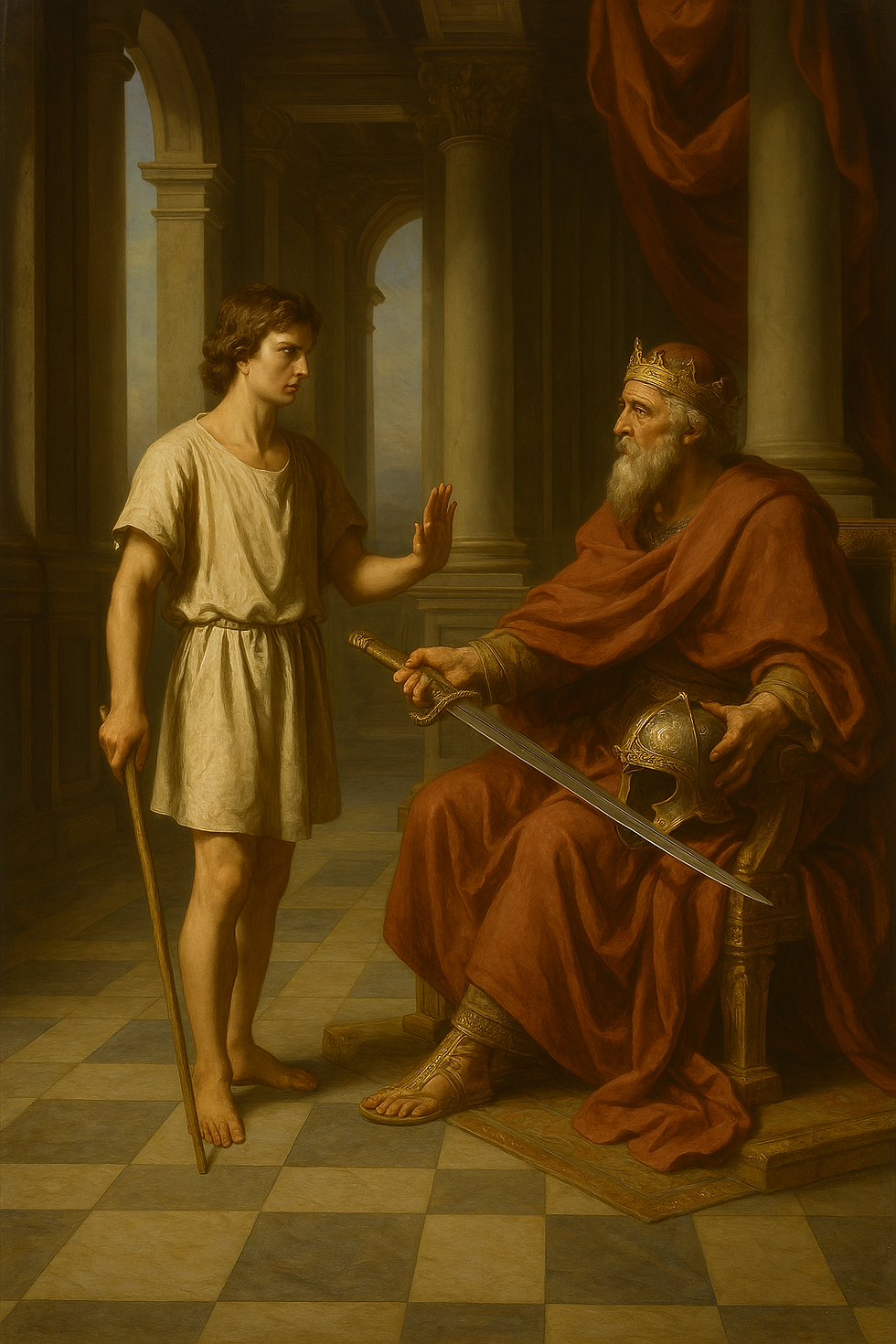
In contrast, David symbolizes the awakened inner child—the part of us that remembers its innocence, that trusts in something beyond form, beyond logic, and beyond fear. He is the soul-consciousness that comes alive in moments of stillness, presence, and meditation. David is not weighed down by Saul’s armor—symbolic of religious dogma, institutional tradition, and inherited beliefs—because true spiritual power does not come from external authorities. It comes from within. David’s refusal to wear the armor represents a shedding of false identities and a return to the authenticity of the soul.
One of the most potent symbols in the story is when David slings a stone into Goliath’s forehead. This act can be seen as a mystical metaphor for activating the third eye—the seat of higher consciousness between the eyebrows. The stone represents focused awareness, clarity, and spiritual will, and the impact at the forehead suggests the disarming of the egoic mind through deep meditation and inner awakening. When our consciousness shifts from identification with the five senses to identification with the soul, the giant that once loomed large in our psyche crumbles. We realize, as esoteric teachings have long held, that the real battle is not with the world outside but with the illusions we hold within.
The valley in which the battle takes place is also significant. It’s not on the mountaintop but in the low places of consciousness, the dark nights of the soul, the moments when we are most vulnerable. Yet it is in these valleys that transformation is made possible. Psalm 23 echoes this: “Though I walk through the valley of the shadow of death, I will fear no evil.” The shadow—the Goliath—is not to be feared but faced, and through that facing, transcended. David’s rise “early in the morning” signifies the emergence of light, the rising of the inner child into awareness, a symbol of spiritual rebirth. Leaving behind the sheep, or thoughts, he enters into stillness—where meditation becomes the battlefield of liberation.

The smooth stones David chooses from the brook represent the five senses, which must be mastered for the soul to rise. Just as Jesus endured the Five Holy Wounds, we too must pass through the crucifixion of the senses to transcend the limitations of the flesh and ego. This is not about asceticism but about awareness—bringing consciousness to the body, mind, and emotions so they become instruments of the soul rather than prisons of identity. When David ultimately slays Goliath and cuts off his head, it is not violence—it is liberation. The head, symbolic of thought and ego, is separated from identity. The false self is no longer in control. The soul becomes the new seat of awareness.

This is the promise and the power of the story. It is a call to each of us to recognize our own Goliath and awaken the David within. Through stillness, through meditation, through childlike trust in the Divine, we can face and overcome the inner beast that binds us. The battle is the Lord’s, not in a religious sense, but in the sense that it is not fought through effort, force, or intellect, but through surrender, clarity, and presence. When we drop the armor, pick up the stone, and aim for the center of illusion, we become free.
So ask yourself: What Goliath is still standing in your way? What parts of Saul’s armor are you still wearing? How might you let the child within rise, step into the valley, and remind you who you really are? Meditation becomes the sacred slingshot. The third eye, the target. And when that stone of truth meets its mark, the giant of illusion falls, and the soul steps forward—victorious, radiant, and free.


Comments